Egg Breaking Machines
Chain-Type Egg Breaking Machine
Also called a chain egg breaker or egg cracking and separating machine.
This machine cracks shell eggs, separates the contents and filters the liquid before it leaves.
- Capacity
- 5,400 – 16,000 eggs/h
- Models
- 2-row, 4-row, 6-row
- Installed power
- 0.3 – 0.4 kW
- Contact material
- SUS304
- Cleaning
- CIP, under 1 hour
5,400 – 16,000 eggs/h 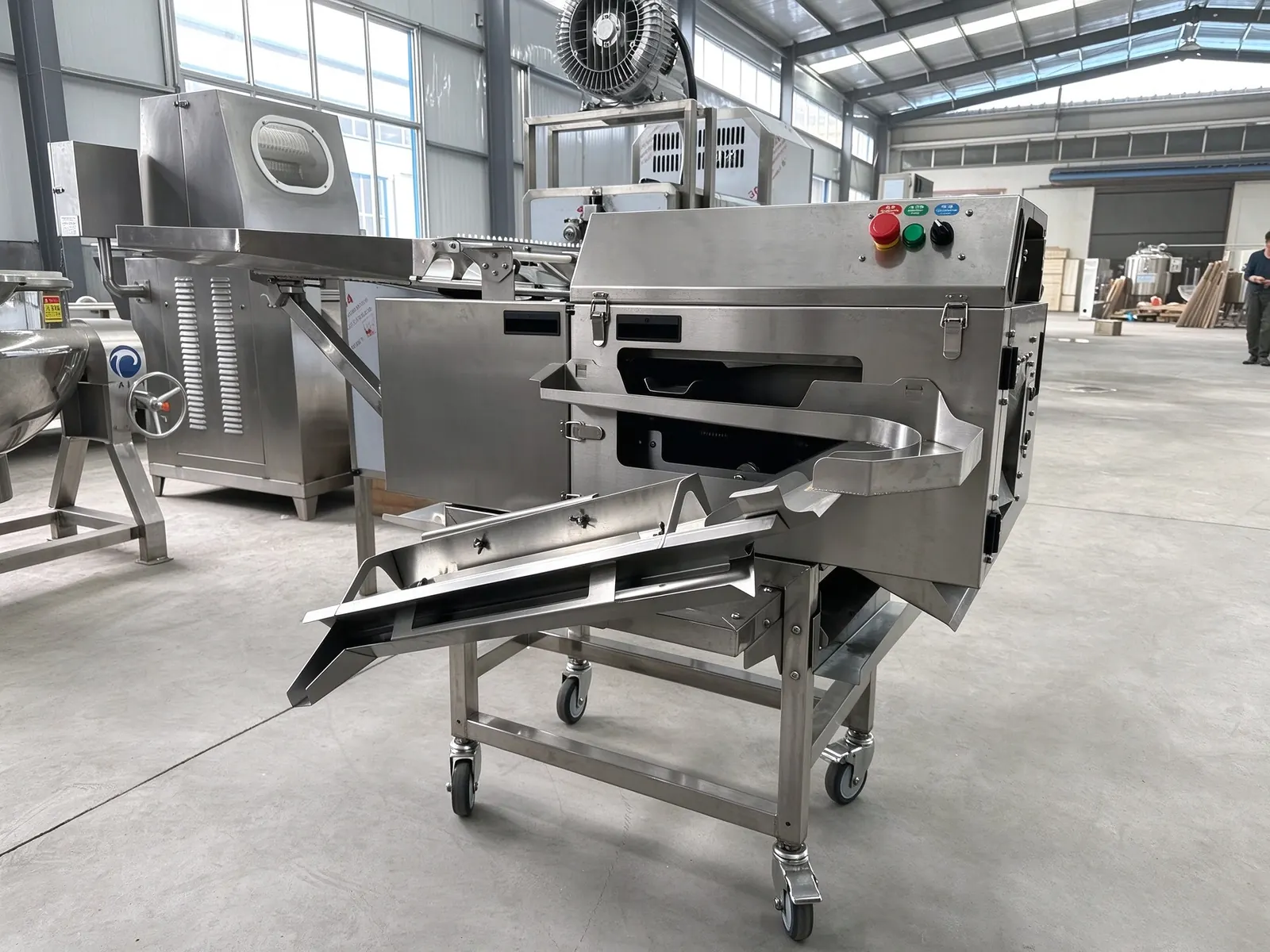
Real photos · our workshop
Chain-Type Egg Breaking Machine: photos and test-run video
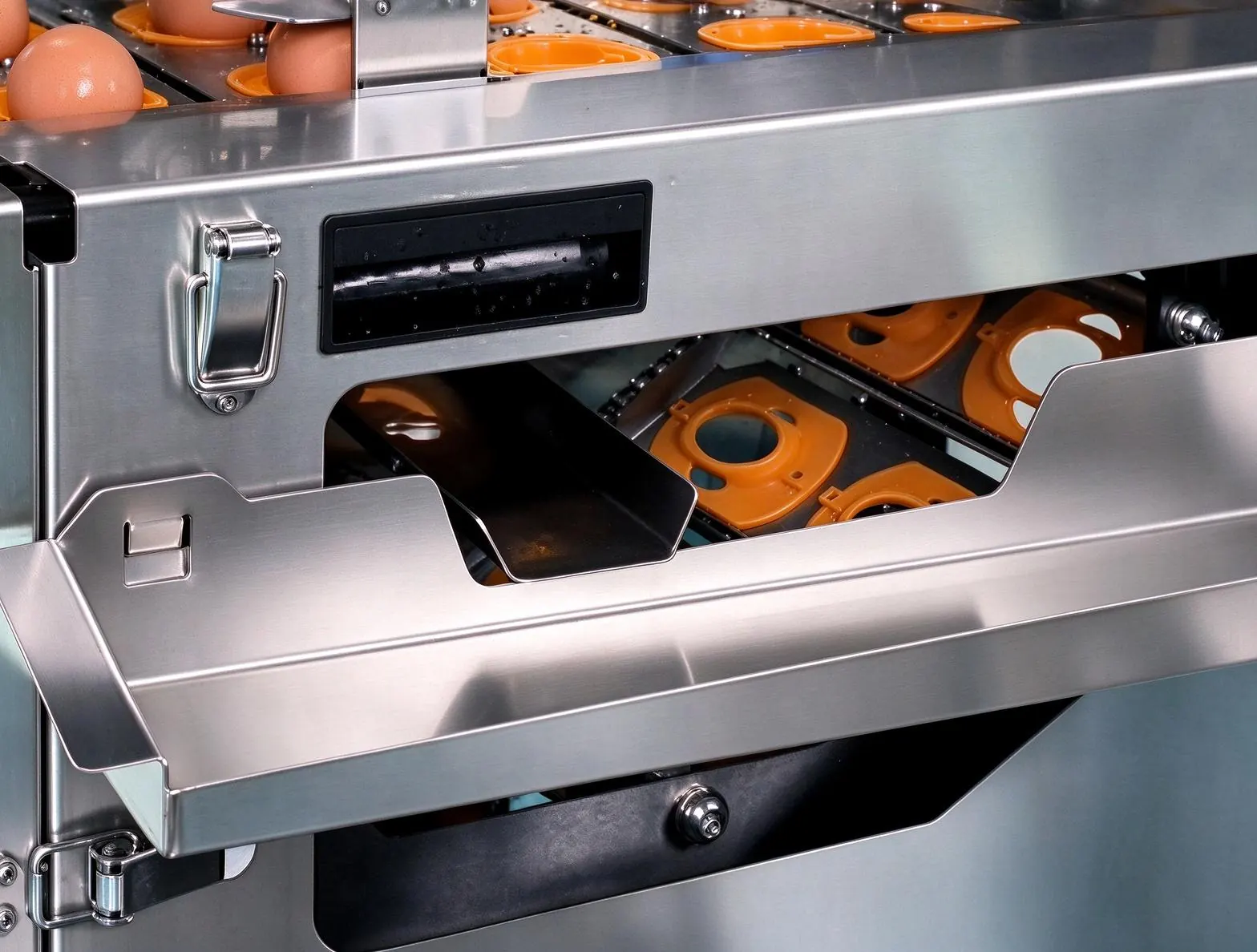
Overview
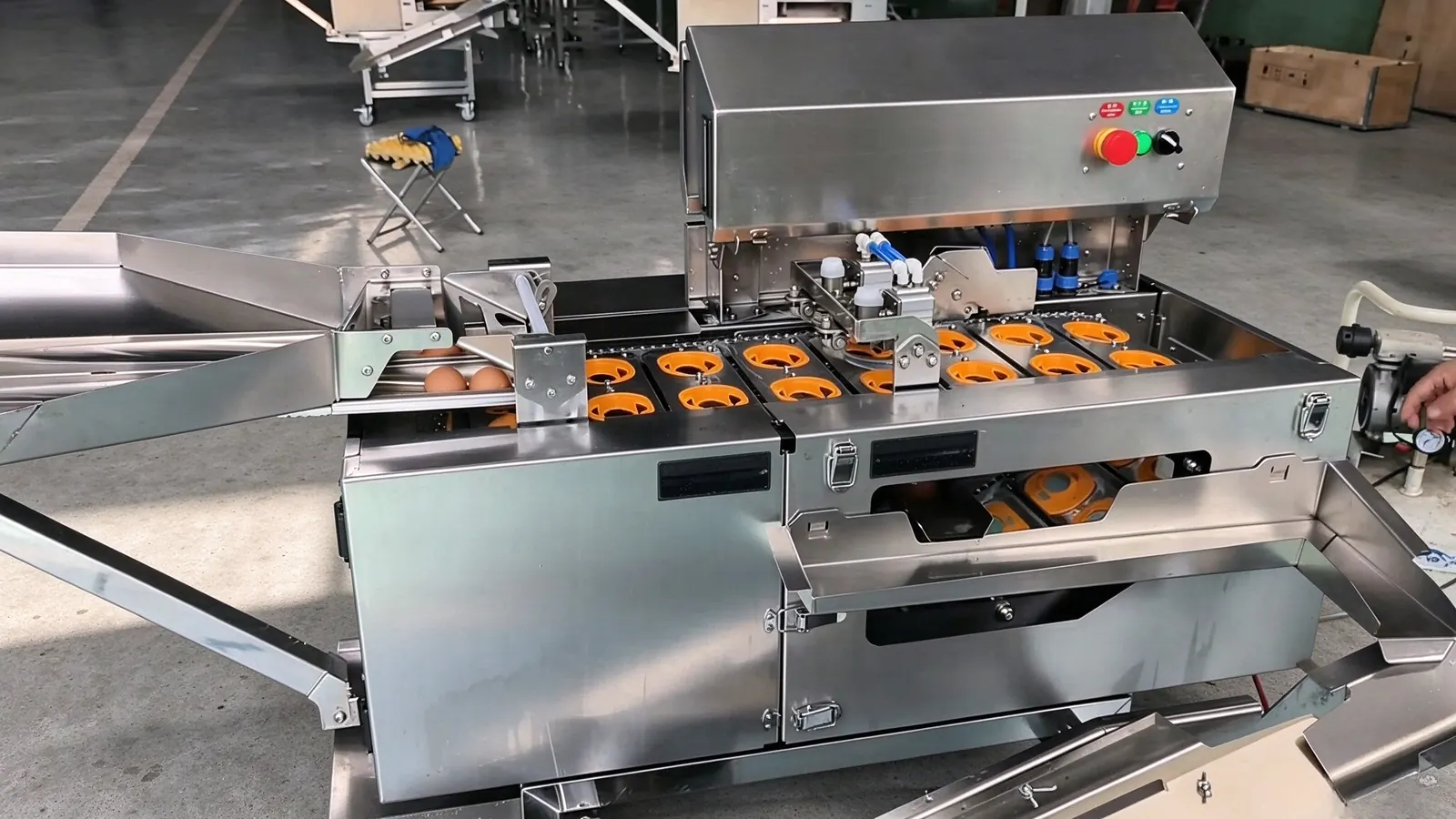
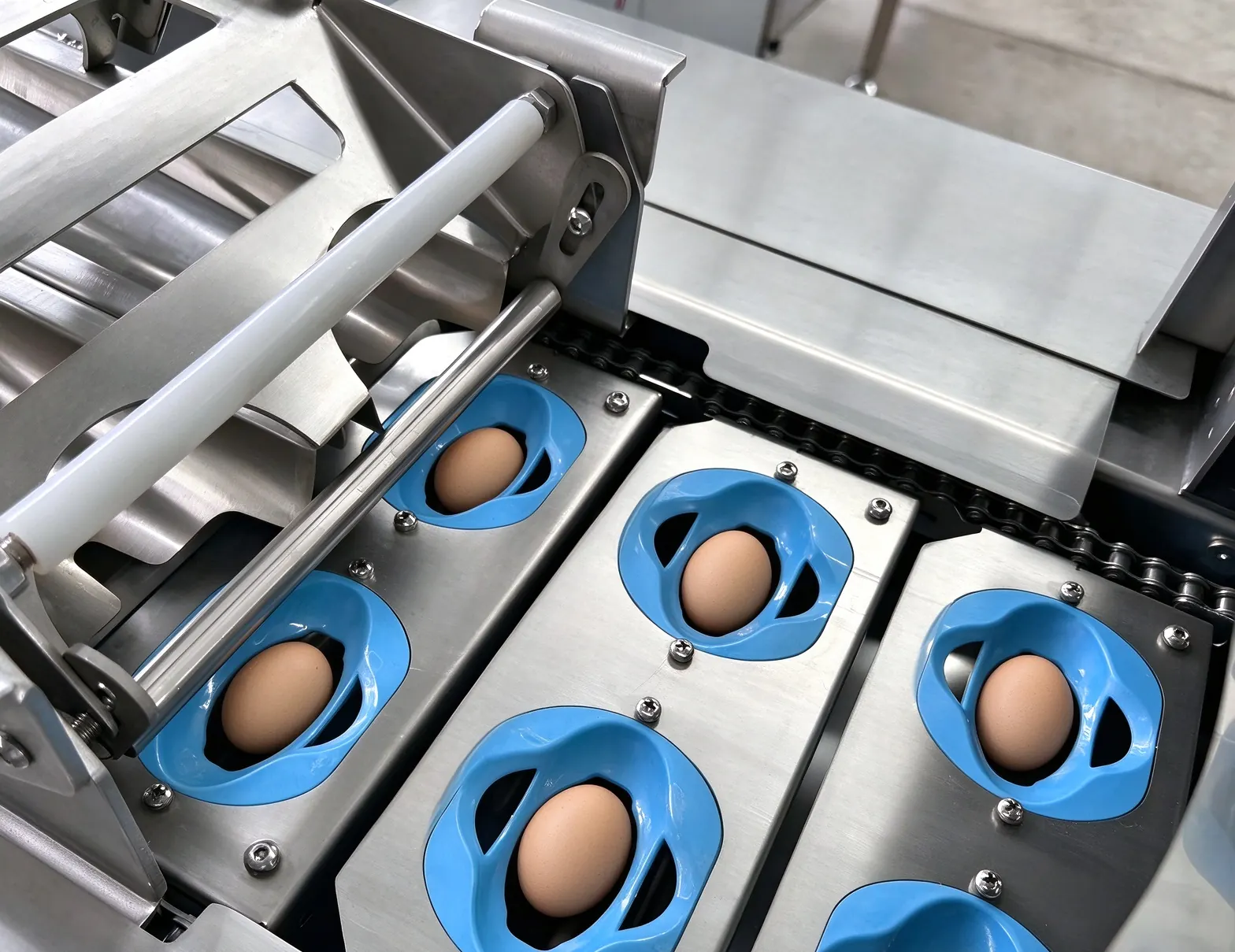
This machine cracks shell eggs, separates the contents and filters the liquid before it leaves. Eggs travel on a chain conveyor with individual cracking heads arranged in rows, so each egg is handled on its own rather than in bulk.
Handling eggs individually is what makes inspection possible. Where contents merge immediately after cracking, one spoiled egg contaminates everything in the buffer tank behind it — and pasteurisation does not reverse spoilage. The inspection position is the reason this machine type is standard in commercial liquid egg production.
The chain layout also makes capacity a matter of adding rows rather than changing machine type: the same cracking head runs on the 2-row, 4-row and 6-row models, so spare parts and operator training carry across the range.
Designed for
- Fresh chicken eggs, washed and dried before breaking
- Graded eggs within a consistent size range
Not designed for
- Unwashed eggs — shell contamination transfers straight into the liquid
- Wet eggs — surface moisture carries contamination through the crack
- Widely mixed egg sizes — yield falls and shell fragments increase
- Cracked or badly damaged eggs, which should be removed before loading
Who this equipment is for
- Egg processors moving from selling shell eggs to selling liquid egg products
- Bakeries, food manufacturers and ready-meal producers breaking their own eggs instead of buying liquid egg
- Egg farms adding processing to capture more value from their own supply
- Contractors building a liquid egg plant for an end client
Less suitable for: Operations breaking a few thousand eggs a day, where manual breaking is still more economical than a machine.
How it works
- Eggs are loaded into cups on the chain conveyor, small end down.
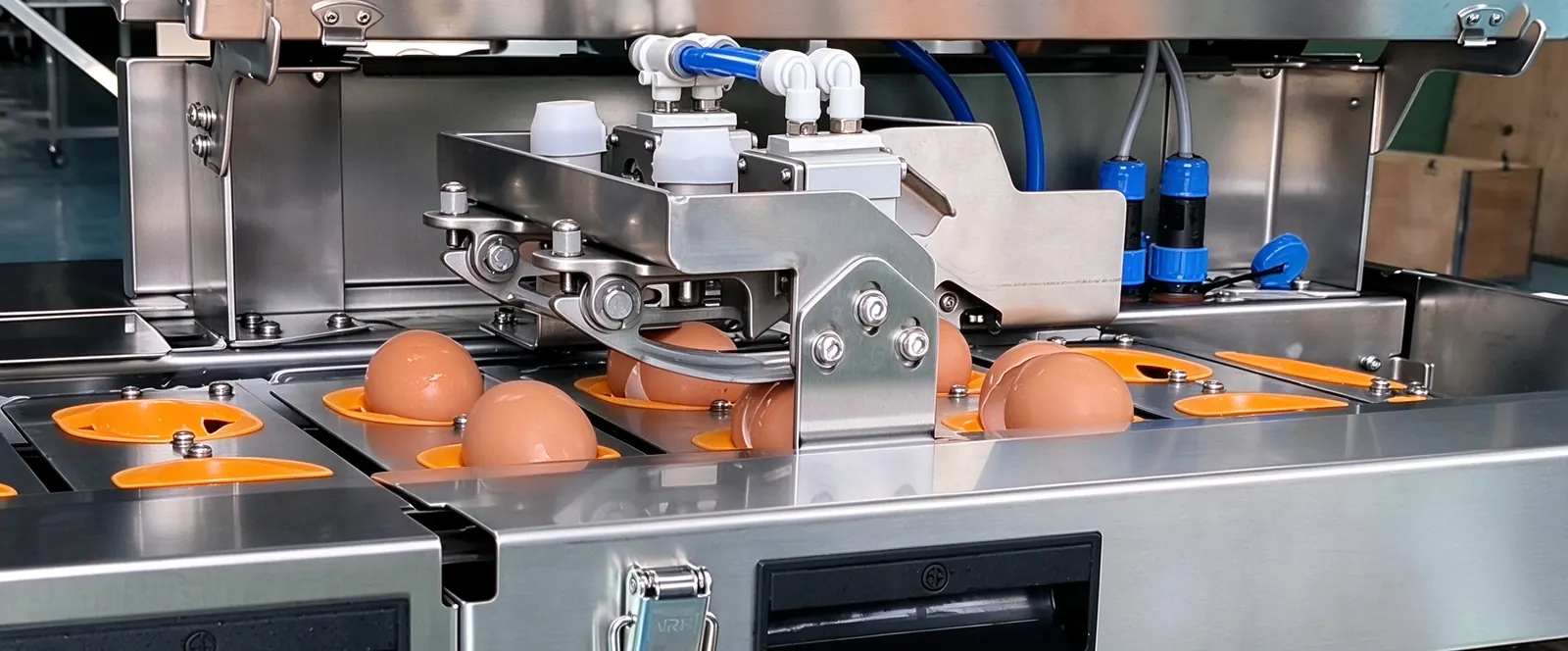
- At the cracking station a blade cracks the shell. Cracking force is adjustable — set too high it shatters the shell and produces fine fragments that pass through filters; set too low the shell does not open cleanly and yield falls.
- The shell halves are pulled apart. White drains through the separating cup while the yolk stays held above it.
- Each cup passes the inspection position, where an operator can reject the contents of an individual egg — off colour, off smell, blood spot, broken yolk — before they join the main flow.
- White and yolk leave through separate channels. For whole egg production the two channels are combined.
- Both streams pass through filters that remove chalazae and shell fragments, then go to buffer tanks or on to the pasteuriser.
Machine structure
- Chain conveyor with individual cracking and separating cups
- Adjustable cracking blades
- Inspection position with reject mechanism
- Separate white and yolk collection channels
- Filters ahead of the outlet
- Shell discharge
- Drive with speed control
- SUS201 frame, SUS304 contact surfaces
- Control panel with Siemens components as standard
- CIP connections
Technical specifications
| Model | Capacity | Cracking heads | Installed power | Dimensions (L×W×H) | Weight |
|---|---|---|---|---|---|
| 2-row | 5,400 eggs/h | 2 | 0.3 kW | 1750 × 1150 × 1050 mm | 170 kg |
| 4-row | 11,000 eggs/h | 4 | 0.3 kW | 1750 × 1450 × 1050 mm | 170 kg |
| 6-row | 16,000 eggs/h | 6 | 0.4 kW | 1750 × 1300 × 1100 mm | 170 kg |
Contact materials: SUS304 + silicone + food-grade plastic. Capacities are machine ratings under a consistent supply of washed, graded eggs; actual throughput depends on egg quality and how the line is staffed.
Material and surface finish
- Product contact surfaces
- SUS304 stainless steel
- Frame
- SUS201 stainless steel
- Internal surface finish
- Ra 0.6 μm
- Welding
- Argon shielded
- Gaskets and seals
- Food-grade rubber
- Material documentation
- Material certificate supplied with every order
Power supply and heating
Installed power is low because the machine moves eggs rather than heats or pumps them — between 0.3 and 0.4 kW depending on the model.
Voltage and frequency are specified per order. Confirming your local supply before manufacturing avoids replacing parts after delivery.
Voltage options: 380 V / 50 Hz · 220 V / 60 Hz · 415 V / 50 Hz · 440 V / 60 Hz · Other supplies on request
Automation and control
Control components are Siemens as standard. If your maintenance team and your local supplier already work with a different platform, we build to the brand you specify instead — Schneider, Mitsubishi and others can be quoted.
This matters more than it looks. A control fault on a line running perishable product has to be resolved the same shift, and that is far easier with a part your local distributor holds than with one shipped from China. Tell us your preference at the enquiry stage and we will quote accordingly.
Cleaning
The machine is cleaned in place. No parts have to be dismantled for a routine clean, and a full cycle runs in under an hour.
Egg liquid residue on contact surfaces is a fast-growing contamination source, so cleaning frequency matters more here than on most equipment. Tell us your shift pattern and we will advise on the cleaning arrangement and where the CIP unit should sit.
Optional configurations
| Option | When it makes sense |
|---|---|
| Whole-egg outlet configuration | Where you produce whole liquid egg only and do not need separated streams |
| Finer filtration stage | Where the downstream product specification is strict |
| Buffer tank and transfer pump | Where the breaker feeds a pasteuriser directly and flow has to be evened out |
| Shell conveyor | Where shell volume makes manual removal impractical |
| Specified control brand (Schneider, Mitsubishi or other) | Where your maintenance team and local suppliers already work with one platform |
Not sure which model fits your throughput?
Send your daily volume and your site conditions. We will recommend a model and explain the reasoning — including a smaller machine than you asked for, if that is what makes sense.
Why buyers choose it
- Each egg is handled in an individual cup, so a single spoiled egg can be rejected before it reaches the buffer tank.
- White and yolk leave through separate channels, so the machine covers both separated and whole egg production without a second machine.
- Cracking force and conveyor speed are adjustable, so the machine can be tuned to the egg quality you actually receive rather than to an ideal supply.
- Filtration is integrated ahead of the outlet, so chalazae and fragments are removed before the liquid reaches storage.
- Cleaning is in place, with no dismantling and a cycle under one hour.
- The three models share the same cracking head, so moving up a size does not change your spare parts list or retrain your operators.
Delivery, packing and installation
- Lead time
- Standard models 20 days; custom builds 20 days; complete lines 40–45 days
- Packing
- Fumigated wooden crates carrying the IPPC mark
- Incoterms
- EXW or FOB Qingdao
- Documents
- Commercial invoice, packing list, certificate of origin, material certificate, English operation manual and drawings
- Installation
- Our engineers travel to site. Typical on-site installation and commissioning is 4 days. Travel and accommodation are covered by the buyer.
- Training
- Delivered on site during commissioning: operation, routine maintenance, and a working session on your process flow.
- Warranty
- 2 years on structural parts (tanks, frames, pipework and fabricated assemblies). 1 year on electrical and electronic components (motors, controls, sensors, PLC and HMI). Excludes misuse, incorrect installation, operation outside specified conditions, lack of maintenance and normal wear parts.
Information we need to quote
- How many eggs per hour, and how many hours per day?
- Separated white and yolk, or whole liquid egg?
- What egg sizes, and are they graded?
- Are the eggs washed and dried before breaking?
- Local voltage and frequency?
- What happens to the liquid next — pasteurising, chilling or direct filling?
- Do you also need a washing line, grading machine or pasteuriser?
Questions buyers ask
How many eggs per hour do I need?
Work back from your egg supply rather than forward from the machine specification. If you can source 80,000 eggs a day and want to run one eight hour shift, you need around 10,000 eggs per hour plus a margin for stoppages — which points at the 4-row model rather than the 6-row. Buying more capacity than your supply supports raises the cost per egg processed rather than lowering it.
What causes shell fragments in the liquid?
Worn or badly adjusted blades, cracking force set too high, weak shells from older or poorly stored eggs, and conveyor speed set above what the egg quality supports. Filters catch most fragments, but the real fix is at the cracking station, not the filter.
Can the machine feed a pasteuriser directly?
With a buffer tank between them, yes. The breaker delivers liquid in surges as eggs are cracked, while a pasteuriser needs constant flow, so a balance stage is required. We can quote the breaker, buffer tank, pump and pasteuriser as a matched set so the flow rates line up.
What are the product contact parts made from?
SUS304 stainless steel, with silicone and food-grade plastic on the cups and separating parts. The frame is SUS201. A material certificate is supplied with every order.
Related equipment
Egg Grading Machine
Used in these lines
Engineering guides
How to Size a CIP System for a Dairy or Liquid Egg Plant
CIP is the equipment most often bought too small. How to size tank volume, flow and the number of tanks from your circuits and cleaning window.
Starting a Liquid Egg Plant: Capacity, Yield and the First Equipment List
Work back from your egg supply, not forward from a machine rating. How to size a first liquid egg line and which stages buyers most often forget.